Environmental Planning & Assessment Caucus
Vision
The Environmental Planning & Assessment Caucus’ (EPA Caucus) members share a common vision of truly effective environmental assessment (EA) in Canada, including the integration of EA into development planning.
What We Do
Through face-to-face meetings and regular communication, the Caucus allows its member groups to bring forward a strong public interest analysis of the many facets of environmental planning and assessment in this country. Among other things, this allows Caucus members to inform the environmental community about developments and issues connected with the Impact Assessment Act and its regulations and allows member groups to fit local initiatives into larger policy contexts.
The strong communication between diverse member groups located in all regions of Canada and the energy, knowledge, and "on the ground" experience of its members make the Caucus the most substantive and dynamic network of environmental assessment expertise in Canada today.
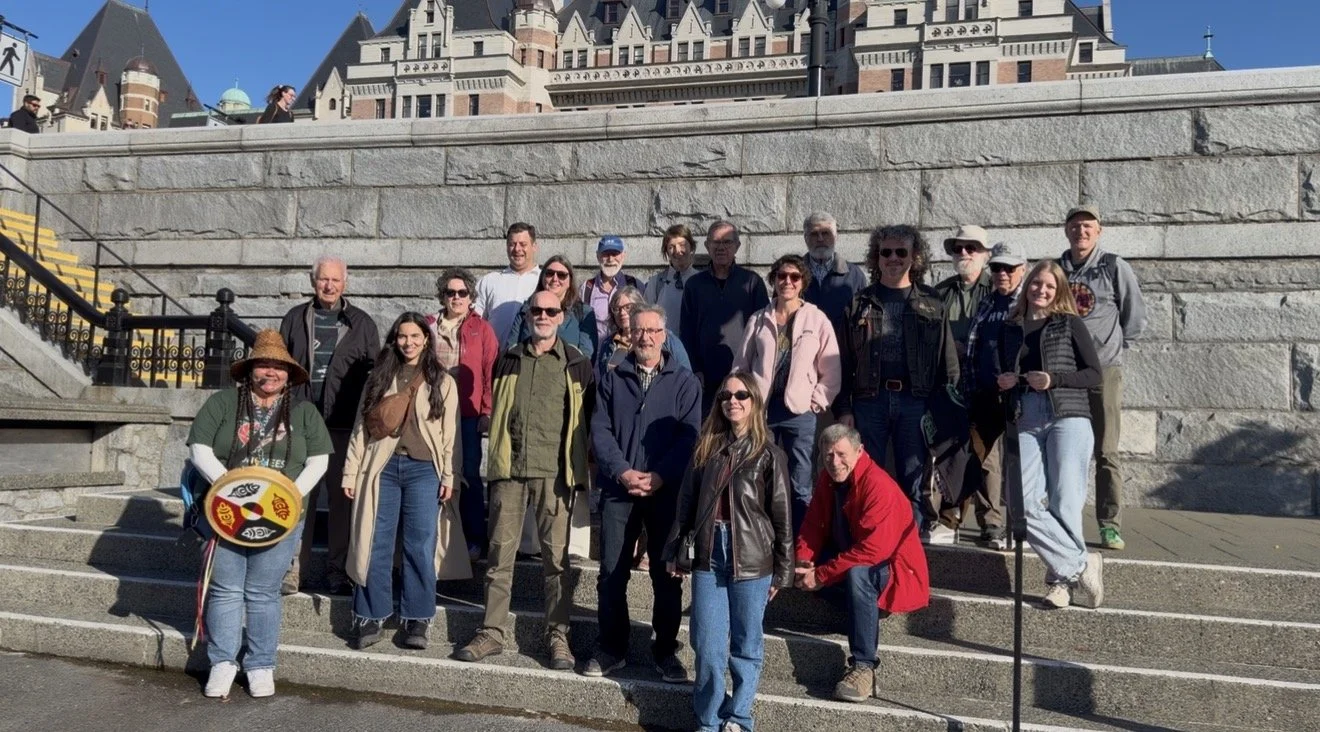
Caucus members met for an in-person meeting from October 16–18, 2026, in Victoria, British Columbia. Discussions focused primarily on Bill C-39 and its potential implications for federal impact assessment processes and major projects across the country, including what proposed legislative and regulatory changes could mean for environmental protection and meaningful public participation.
EPA Caucus Responds to Bill C-39
Building on discussions at our October 2026 in-person meeting in Victoria, BC, the EPA Caucus has continued its work to address concerns surrounding Bill C-39, the Building Canada Strong Act, and its potential implications for federal impact assessment and environmental protection.
Following the meeting, the Caucus developed two submissions outlining its position on the proposed legislation and recommendations for addressing its potential impacts. These include a letter to Prime Minister Mark Carney calling for the withdrawal of Bill C-39, and a detailed submission to the House of Commons and Senate committees reviewing the legislation, identifying priority amendment areas to strengthen environmental protections, transparency and accountability, and meaningful participation.
Read the Caucus's submissions:
Fall 2026 Webinar Series
Resource Nation: Public Engagement in the Fast-Tracking Age
Webinar 2: November 9 from 2-3 PM ET
Nuclear Expansion, Major Projects, and the Environment: What’s at Stake for Communities and Rights-Holders?
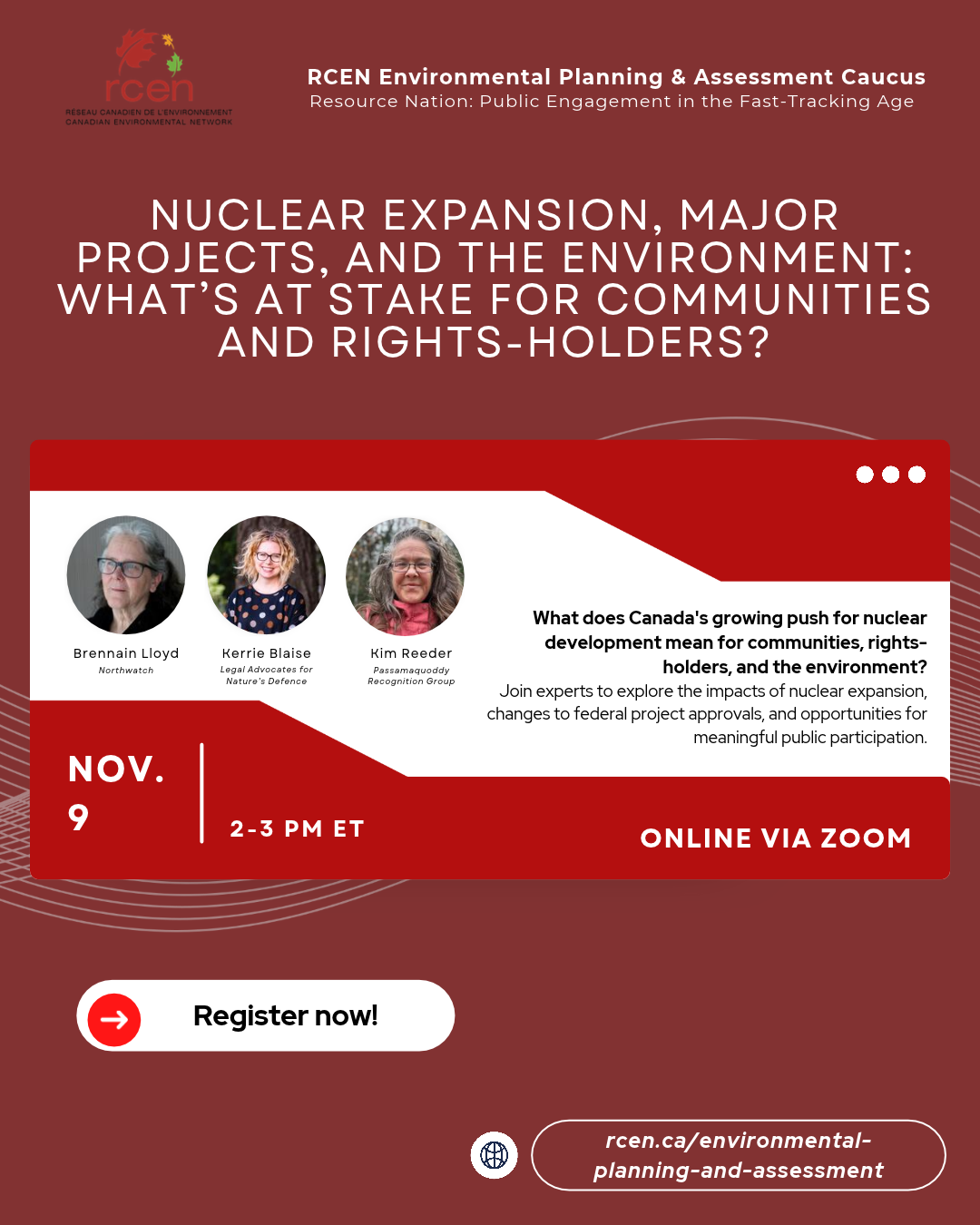
Canada is experiencing renewed interest in nuclear energy, with governments and industry looking to expand nuclear power generation and advance new projects across the country. But what does this growing interest mean for communities, Indigenous rights-holders, and the environment? The webinar will examine different types of nuclear projects and their potential impacts on communities, opportunities for meaningful community and rights-holder participation, and how Bill C-39 and other federal legislative changes, including the Building Canada Act and Nuclear Safety and Control Act, could affect environmental oversight and public participation in project decision-making. The discussion will also highlight opportunities for public engagement and ways communities can make their voices heard as nuclear development moves forward. Join us for a conversation with community organizers and environmental and Indigenous law experts Brennain Lloyd (Northwatch), Kerrie Blaise (Legal Advocates for Nature's Defence), and Kim Reeder (Passamaquoddy Recognition Group) as we explore the implications of nuclear expansion and the changing regulatory landscape.
Panelists:
Brennain Lloyd: Brennain Lloyd is a community organizer and public interest researcher and writer in northeastern Ontario. For the last 30 plus years, Brennain has worked with environmental, peace and women’s organizations as a facilitator and adult educator supporting public participation in environmental and natural resource decision-making and various planning processes.
Brennain’s primary organizational affiliation is with Northwatch, the regional coalition of environmental and social groups in northeastern Ontario formed in 1988 to address regional issues related to energy, forests, waste management and water quality and – on a recurring basis – nuclear waste burial schemes.
Kerrie Blaise: Kerrie Blaise is an accomplished lawyer practicing in the fields of environmental and Indigenous law and the 2026 recipient of the esteemed Guthrie Award. She is one of only a handful of public-interest environmental lawyers serving Northern Ontario and in 2023, founded the environmental law non-profit, Legal Advocates for Nature's Defence. At LAND, she works to advance the protection of Indigenous rights and nature in response to urgent threats to lands and waters and amplify community voices – whether in the courts, before lawmakers or in public forums – to precipitate change.
Kim Reeder: Kim Reeder is a settler who works for the Passamaquoddy in what is commonly referred to as southwest New Brunswick. Her primary work is focused on nuclear power generation and its impacts.
In Passamaquoddy homeland, the Point Lepreau Nuclear Generating station has operated since the early 1980s and currently, there are plans by the government and NB Power to expand nuclear development.
Webinar 1: October 13 from 2-3 PM ET
Bill C-39, Major Projects, and the Environment: What’s at Stake for Climate and Nature?
Bill C-39 is the Carney government’s latest set of measures to dramatically weaken Canada’s environmental laws. Coupled with Bill C-5 and recent regulatory and policy changes, it amounts to the effective evisceration of federal impact assessment and could lead to the extinction of iconic species at risk, including the Southern Resident Killer Whale. This webinar will unpack what Bill C-39 does and what it means for nature and climate.
Join us for a conversation with experts from West Coast Environmental Law, Wildlife Conservation Society Canada, and Ecojustice as we explore the proposed approach.
The webinar will provide an overview of Bill C-39 and related regulatory and policy changes and their implications for communities, climate, biodiversity, and perspectives on how Canada’s nature and climate priorities could be better integrated into major project decision-making.
Join our panel of environmental experts Anna Johnston (WCEL), Justina Ray (WCS Canada), and Isabel McMurray (Ecojustice) as they unpack Bill C-39 and what it means for Canada.
Winter 2026 Webinar Series Resources
Webinar 1: January 15 from 2-3 PM ET
What’s Going on with Federal IA? Public Engagement in Nation-Building Times
The federal government, along with some provinces, are rewriting the rules to fast-track projects deemed to be in the national interest. Some of those rules, like Bill C-5, the Building Canada Act, do not require public participation in major project decisions. What do these changes mean for federal impact assessment and the public’s ability to have a say in decisions that affect them? In this one-hour webinar, Anna Johnston, John Sinclair, and Tina Northrup discuss the changes and how the public can be meaningfully involved.
Webinar 2: February 12 from 2-3 PM ET
Regional Assessment: The Path to More Efficient, Effective and Trustworthy Project Decisions?
The federal government’s economic agenda includes fast-tracking projects it considers nation-building. Simply cutting timelines risks environmental disaster and Indigenous and public opposition, but can regional assessment offer a better solution? Join experts for this one-hour webinar about how regional assessment can make project decisions more informed, fair and efficient.
Publication: Impact Assessment Act 101

IAA 101: A Guide to Public Participation in Impact Assessment Act Processes
Publisher: Environmental Planning and Assessment Caucus of the Canadian Environmental Network
Authors: Kostantina Northrup and Mike Kofahl (East Coast Environmental Law), Anna Johnston (West Coast Environmental Law) and Kerrie Blaise (Legal Advocates for Nature’s Defence)
Subject: Impact assessment, public participation, Indigenous engagement
This guide to public participation in impact assessments is a must-read for anyone considering participating in an assessment under Canada’s Impact Assessment Act. It describes what impact assessment is, outlines key reasons people often participate, explains the difference between public participation and Indigenous engagement and consultation, and talks about key players in the assessment process. It explains the various steps of an assessment under the Impact Assessment Act, from how projects are designated, the various stages of assessment, to follow-up and monitoring after assessments conclude. It also describes strategic and regional assessments, as well as environmental screenings for smaller projects on federal lands. Throughout, it offers tips and resources for how to maximize your participation.
Steering Committee
-
Anna Johnston (Co-Chair)
West Coast Environmental Law, BC
-
Dawn Hoogeveen (Co-Chair)
Indigenous Centre for Cumulative Effects, BC
-
Gary Schneider
Environmental Coalition of Prince Edward Island, PEI
-
Jamie Kneen
MiningWatch Canada, ON
-
Jason Unger
Environmental Law Centre, AB
-
John Sinclair
Manitoba Eco-Network, MB
-
Lisa Mitchell
East Coast Environmental Law, NS
-
Michael Poellet
Inter-Church Uranium Committee Educational Cooperative, SK
-
Peter Duck
Bow Valley Naturalists, AB
-
Roberta Frampton Benefiel
Grand Riverkeeper Labrador, NL
-
Stephen Hazell
Nature Canada, ON
-
Victoria Goodday
Wildlife Conservation Society, NS
For further information or to join the caucus, please contact: outreach@rcen.ca
Latest Caucus Submissions
October 3, 2024
In July 2024, the Impact Assessment Agency of Canada released a Discussion Paper on the Project List Review under the Impact Assessment Act (IAA). In response, the Environmental Planning and Assessment (EPA) Caucus of the Canadian Environmental Network (RCEN) has submitted detailed comments, offering recommendations on key areas of concern. These include the amendments made through the Budget Implementation Act, 2024, the evidence supporting proposed changes, and the transparency of the overall process.
The EPA Caucus' submission emphasizes the importance of a credible and transparent Project List that effectively captures physical activities with the potential for significant environmental impact. Our recommendations aim to improve both the process and outcomes of project-specific impact assessments, ensuring they address sustainability, cumulative effects, and public participation. Without such reforms, there is a risk of undermining the ability of impact assessments to safeguard ecological integrity.
Additionally, the submission draws on the expertise of the Caucus' Designations, Amendments, and Project List Working Group, supported by consultations with the Caucus Steering Committee and allied environmental groups. It represents the consensus recommendations of the EPA Caucus, reinforcing the need for a revised and robust Project List framework that better reflects the environmental challenges Canada faces today.
Submission on the Impact Assessment Agency of Canada Discussion Paper on the Project List Review
October 11, 2024
In October 2024, the Federal Lands Working Group of the Environmental Planning and Assessment (EPA) Caucus of the Canadian Environmental Network (RCEN) submitted comments on the proposed Ministerial Exclusion Order under the Impact Assessment Act (IAA). The Working Group voiced concerns about the lack of transparency and insufficient public data to justify expanding the number of projects excluded from federal impact assessments, aligning with critiques from the Manitoba Eco-Network.
The submission highlights three primary issues: inadequate implementation of the Sections 81-91 process, lack of evidence ensuring that additional exclusions will cause only insignificant environmental effects, and the need to exclude projects on sensitive federal lands from the exemption list. The Working Group recommends that the Impact Assessment Agency prioritize public accountability and improve evidence-based decision-making, especially regarding the ecological context, to avoid significant or cumulative environmental impacts.
Submission on the Proposed Ministerial Exclusion Order under the Impact Assessment Act
Caucus Working Groups
Our caucus working groups are always open to new members! By joining a topic-specific working group, you can engage with focused discussions, stay informed on the latest developments, and contribute to collaborative efforts that drive impactful change. Whether you are an expert in the field or simply passionate about making a difference, your participation is valued and essential to our collective success.
Working groups include Designations, Amendments, and Project List, Regulatory Efficiency, Critical Minerals, Strengthening Federal Lands EAs, Regional Assessment, Public Participation, and Communications.
To join the caucus or a working group, please email outreach@rcen.ca.
Links to Federal and Provincial Impact Assessment Departments
Resources
Environmental Assessment Review Process
Materials related to the review of federal environmental assessment processes, including the work of the Expert Panel and the parliamentary review of Bill C-69.
Caucus Submission to the Impact Assessment Agency of Canada Regarding the Draft Policy Framework for Regional Assessment under the Impact Assessment Act February 28, 2023
Caucus Submission to the Impact Assessment Agency of Canada on the Agency’s review of its guidance respecting sustainability, Gender-Based Analysis Plus (GBA+) and environmental obligations and commitments. January 20, 2021
Letter to Ministers from 5 ENGOs re: Reforming Federal Environmental Assessment Law. August 30, 2017
Caucus Submission on the Government of Canada’s Environmental and Regulatory Reviews Discussion Paper. August 28, 2017
Reactions to and comments on the Environmental and Regulatory Reviews Discussion Paper. August 28, 2017
Still a long way to go: an analysis of the federal assessment processes Discussion Paper in light of next generation assessment requirements. Robert B. Gibson, July 8, 2017